Wednesday, March 12, 2008

Being a Priest in Public

I still feel pretty green when it comes to being a priest, but at least one part of this vocation has settled a little. I've blogged about wearing clericals before, and about how unsure I've been about when to wear them and when not to wear them. At this point I'm pretty settled in a routine of wearing clericals whenever I am formally in persona ecclesiae - whenever I am personally representing the church. In the liturgy, for sure, under my alb and chasuble; during pastoral care visits; at most church meetings. It turns out that I'm in clericals just about every day, except my day off, or if working from home.

Being in personal ecclesiae, it turns out, gives opportunity for some extremely varied reactions, and this came to a sharp point two nights ago. I was at a public event for the upcoming work of the Truth and Reconciliation Commission, an opportunity for us to listen to the stories of the survivors of the residential school experience. I wore clericals, thinking that even if they might have hurtful associations for some, truthfulness and honesty is what this day is about. And I am a cleric in a church that has some responsibility for some shattered lives.

The public perception of "the church" was bundled up for me in two vastly different interactions. One man, who I've never met nor laid eyes on before, came directly up to me, smiling broadly, then shaking my hand vigorously, only to go on along his business. (He was white.) When Archbishop Fred Hiltz was speaking, another woman began yelling "Liars! Bullshit! Bullshit! I'll never forgive no priest! They're all liars!" She walked towards my furiously, giving my shoulder a good knock as she went by. (She was aboriginal.)*

Being in this kind of representative role for the church at this time - in persona ecclesiae - is not simply to be honoured and respected, as it once was. It also means bearing the burden of the sins of the church in very personal ways. And it is, whether I choose it to be this way or not, part of the vocation of personal representation of the church.

*Surely things are more complex than this, as there are many aboriginal Christians who are happy with the church, and also many white people who are very unhappy. But that this happened this way, at this particular event, is no coincidence.

Labels: ,

Tuesday, September 20, 2005

More on the Clericals

I have been wearing my collar, in case anyone is wondering, and I am tempted to keep doing this. There are distinct disadvantages, I know. But it helps in a number of ways.

For one, I am immediately recognizable. Consider me in my environment: I'm a guy in a wheelchair in a hospital, and even in regular clothes, I must look a lot like a patient. But as I have grown into my new priesthood, I have begun to realize that in clericals I am seen first as priest, then as a person in a wheelchair. This has caused its own twists of perception, for me and the people around me. But in the hospital, if I can be perceived first as a religious professional, especially to the other health-care professionals, this will be to my benefit because I will be thought of as a chaplain in a chair rather than that guy in the chair who is also a chaplain. When I did my first unit of chaplaincy a couple of years ago, I had a hard time with staff remembering me as a chaplain, referring me to patients, and referring patients to me. I now wonder if this dynamic contributed to this problem.

The second advantage is that there is no bones about why I am in the room with a patient: I am there as a chaplain, as a religious person. This can go both ways, as some of you have pointed out. It might make me less approachable. But not yet. It has, instead, with folks who self-proclaim to be hostile to religion, made the starting terms of the discussion apparent. People immediately perceive my religious committments, and this has begun discussion rather than limited it. I think this might be because, in clericals and a chair, I present as such an enigma that inter-personal barriers fall due to simple curiosity.

All said, I have just started. Time will tell what is best. I hope to remember that each decision I make should be in the service of the patient, not my ego or some abstract sense of identity. If I can remember that I am first a servant, and second a priest, this will serve us all well.

Labels:

Saturday, August 27, 2005

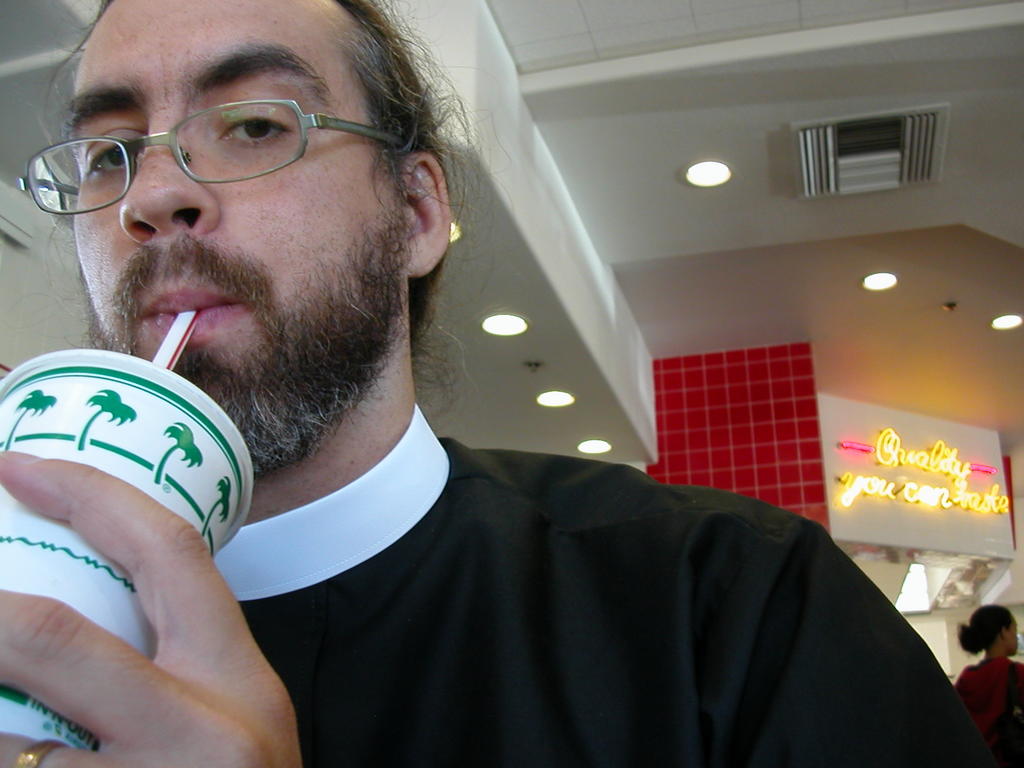
Clericals and a Chocolate Shake

We are off to St. Stephen's early tomorrow morning. St. Stephen's is where I did two semesters of field education, while serving as a deacon, for about nine months last year. I would have remained there as a priest if I could have, but alas, it is now much too far away. Karen and I will rise at about 5:15am to hit the road at 6am and be in Belvedere at 7:30am. We will do three hours of driving altogether. Ok for the occasional visit, but as a regular gig? It's not worth that kind of commute.

We do get a treat when we go to St. Stephen's, though. We go to In-N-Out Burger for lunch. Well, perhaps not exactly true . . . I go to In-N-Out, Karen gets a bagel at the deli.

For me I get a kind of perverse satisfaction out of wearing my collar in places where it might not be expected. I am not one of those priests for whom ordering that set of clerical collar pajamas almost seems appropriate, but I will wear the gear out in public. I remember one of the first times I was out it in public in the collar, I was shopping for a suit jacket for Sunday mornings. I went to get a burrito at a restaurant near the clothing store. When I went up to get some salsa, I could feel the distraction of me in the clericals. The eyes followed me across the restaurant floor. Another patron at the salsa bar did not just do a double take, but a triple take. First look, a dude getting salsa. Second look, a wheelchair dude getting salsa. Third look, is that wheelchair dude getting salsa super-religious or something? Suffice it to say, the last take resulted in a look of utter consternation and salsa all over the floor.

Let's hope nobody spills his or her food tomorrow. But it is a good feeling to get odd looks for clericals, rather than just being in the chair, at least once in a while.

Labels:

Monday, July 24, 2006

Meeting +John-David

And how I learned something about Church politics.

As some California bishops begin presentment proceedings against another California bishop, I thought I might tell a story about +John-David of San Joaquin. He's been in the Episcopal news lately because he's being charged with abandoning communion. In all honesty I'm not sure why, but according to these sources it has something to do with diocesan canons, and what some think he might do in the future. But the story is unfolding, and there is much more to this story than what we see in the news. It's an important story as any in the battle over who is genuinely Anglican in the United States. It's worth following.

It's worth following because the Diocese of San Joaquin is on the shortlist of dioceses disliked by the liberal establishment of the Episcopal Church, and will tell us much about how those on the edges of the Episcopal Church are treated by those closer to the centre of power. My own relationships in the Episcopal Church have developed within the perifery of the liberal establishment (though Presiding Bishop elect, +Katherine Jefferts-Schori, is a graduate of my seminary), and most of the voices I know here are fully consonant with the power-voices within the Episcopal Church, like that of presiding bishop ++Frank Griswold and the national church bureaucracy. All that is to say that I had never heard many good things about +John-David, until a conservative friend came under his wing after this friend came into some conflict with his own diocese over some familiar theological and ecclesial issues.

I went to Howard's diaconal ordination, but with some trepidation. As uncomfortable as I am with much of the politicking and theology of the Diocese of California, San Joaquin also has positions and policies that are at variance with those of my own diocese. I wondered to myself, should I insist on processing in the clerical procession? Should I even wear my clericals? I wasn't sure that my orders were recognised in San Joaquin. I was licensed in the Diocese of California, a diocese as different from San Joaquin as you can get. In the end I decided not to process, but I did wear my clericals. I'm sure of the validity of my orders, even if I wasn't sure that this diocese would recognise them.

At the end of the ordination I entered the receiving line along with everyone else. I was anxious to meet the bishop, as most of the bishops I've met (though not all, to be sure) have more serpentine wisdom than dove-like gentleness. Here I was, a crippled deacon from the Diocese of California, meeting one of the most conservative bishops in the Episcopal Church. I didn't know how this bishop would receive me.

As it turns out, I had nothing to worry about. +John-David held my hand tightly and smiled broadly when I met him. He was radiant, and genuinely interested in me and how I was doing. He spoke lovingly of his own time in the Diocese of California, and of some of the people we both knew. He was curious about me being a Canadian in California. He wanted to learn about my ministry in Marin County. In short, +John-David won me over with his gentleness and pastoral presence.

Are meetings like this a solution to our deep divisions? No. I'm not that naive. But the opportunity to meet, face-to-face, someone as demonised as +John-David, certainly revealed some things that I have a hard time remembering: There are a lot of good men and women on both sides of this chasm. Don't believe the demonisers. And above all, reach out to all those you meet with love, affection, and charity, just as +John-David did with me. If he had relied on his own preconceptions, he would have had every reason to look another way.

Instead, he reached out his hand, and taught me something about Christian charity and hospitality.

Labels: ,